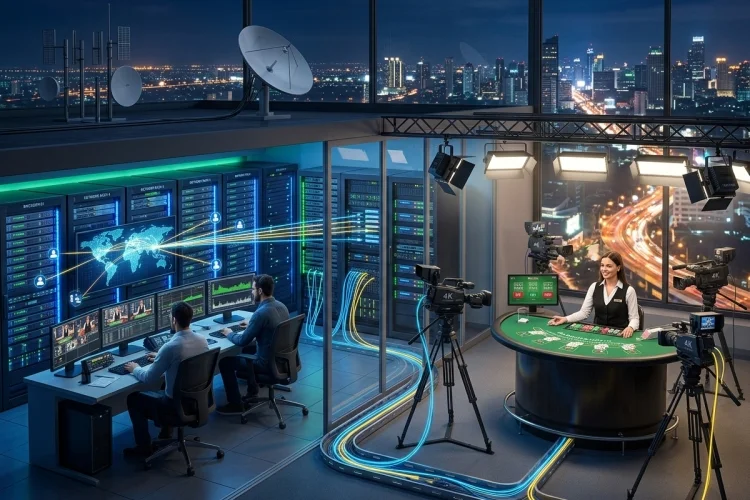
A live dealer table looks simple from the player’s side: open a game, watch the host, place a bet, and wait for the result.
Behind that smooth screen is a connected chain of cameras, encoders, servers, delivery networks, and interactive software. Every part must work quickly enough to make the round feel genuinely live.
Streaming technology turns a physical studio into a playable online experience. It carries video and sound while a separate platform manages wagers, timers, results, and account balances.
Understanding how a Live Casino Game reaches your screen also explains why connection quality, device performance, and low latency matter.
The Stream Begins in a Real Studio
Professional cameras capture the dealer, table, cards, wheel, or game-show equipment. Microphones record speech and relevant sounds, while lighting keeps important details readable.
Several angles may be available, especially for roulette and card games. Commercial suppliers describe using multi-camera production and HTML5 interfaces to serve live games on both desktop and mobile devices.
Encoding Makes the Feed Easier to Send
Raw studio video is far too large to deliver directly to thousands of players. An encoder compresses it into a practical digital stream while trying to preserve details such as card values and wheel movement.
The system may create several quality levels. A strong broadband connection can receive a sharper version, while a weaker mobile connection may use a smaller stream that requires less data.
Low Latency Keeps the Action Relevant
Latency is the delay between an event in the studio and its appearance on your screen. Too much delay would be confusing when betting closes before a card is revealed or a wheel begins to slow.
Low-latency services reduce this gap through faster capture, encoding, transport, and playback. AWS notes that geography, network speed, protocols, and other parts of the delivery chain can all affect the final delay.
Betting Data Runs Beside the Video
The picture is only half of the experience. The interface must also display chips, accepted wagers, table limits, countdowns, results, and account balances.
These details are usually handled as structured data rather than permanently placed inside the video. This lets the platform resize controls for phones, translate menus, and show personal account information while many viewers watch the same table.
The video and betting system must remain synchronized. A wager needs to reach the server before the official closing point, regardless of what the player thinks they see on a delayed stream.
CDNs and Adaptive Quality Improve Delivery
A content-delivery network distributes the stream through servers closer to viewers instead of forcing everyone to connect directly to the studio. Google describes Media CDN as an edge network built for streaming media and other high-throughput workloads.
Adaptive bitrate streaming then changes video quality according to network conditions. The image may become softer when bandwidth drops, but this can reduce buffering and keep the round visible.
Fair Operation Requires More Than Video
A clear picture does not automatically prove that a game is fair. Regulated studios may need trained dealers, documented procedures, supervision, access controls, surveillance, and game logs.
The UK Gambling Commission requires licensed live dealer operations under its standards to be fair and independently auditable. Its guidance also calls for surveillance detailed enough to confirm whether dealing procedures and game rules were followed.
Streaming technology powers a Live Casino Game by connecting studio production, video compression, low-latency transport, distributed delivery, and an interactive betting interface.
Each layer helps keep the action, timer, wagers, and results clear and consistent. Before playing, test the stream, read the table rules, and check what happens if your connection drops.
Use only licensed services where online gambling is legal, set a fixed entertainment budget, and never assume a faster or sharper stream improves the odds. Good technology should make the experience easier to understand, not encourage longer or riskier sessions.