


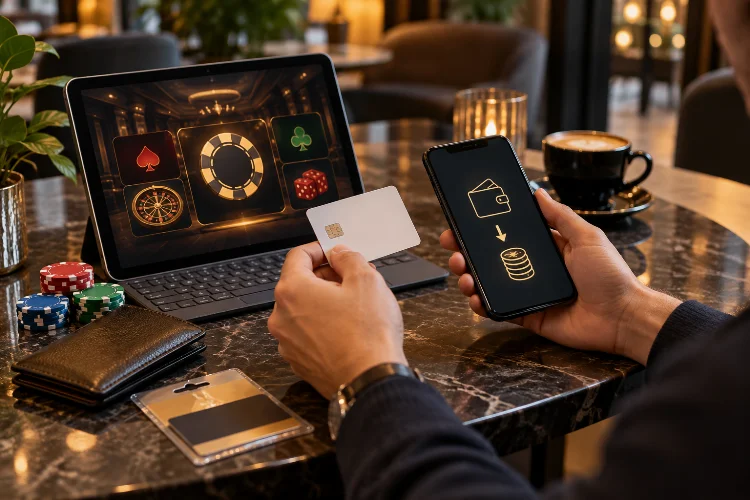
Not everyone wants an online casino connected directly to a bank account or credit card. Prepaid payment methods offer another option: load money first, then spend only from that available balance.
Prepaid Cards for Online Casino Deposits can include network-branded reloadable cards as well as voucher-style services such as PaysafeCard. They can make budgeting relatively straightforward because you generally cannot spend beyond the amount already loaded.
However, casino acceptance, identity checks, fees, withdrawals, and gambling restrictions can differ considerably between products and countries.
What Is a Prepaid Card?
A prepaid card gives you access to money that has been loaded in advance.
Unlike a credit card, it does not normally provide a line of borrowed money. Unlike a traditional debit card, it is not necessarily linked directly to your everyday bank account.
The U.S. Consumer Financial Protection Bureau explains that prepaid and debit cards generally let consumers spend money they already have, while credit cards involve borrowing. Reloadable prepaid cards can accept additional funds, while some products are non-reloadable.
That distinction can make prepaid payment methods attractive to people who prefer to separate a fixed entertainment budget from their main banking balance.
Still, “prepaid card” is a broad category. A Visa- or Mastercard-branded reloadable card can work differently from a 16-digit prepaid voucher.
How Prepaid Casino Deposits Work
The basic process is usually simple.
You first buy or load the prepaid product. Then you open the casino cashier, select the relevant payment method, enter the deposit amount, and provide either card details or the prepaid-code information requested.
A network-branded prepaid card can often travel through the same card-processing infrastructure as other payment cards. Gambling merchants are identified through specific merchant category codes.
Visa, for example, uses MCC 7995 for many online gambling transactions, with specific alternative codes applying to certain government-licensed U.S. gambling businesses.
The card provider can therefore recognise that the merchant is connected with gambling and decide whether that category is permitted.
Voucher systems work somewhat differently.
PaysafeCard, for example, allows users in supported regions to purchase prepaid codes and enter a 16-digit code at participating online merchants. Registered accounts can also hold prepaid balances and offer different transaction limits.
Prepaid Cards Can Help Create a Fixed Spending Boundary
One obvious feature of prepaid payments is that funds normally need to be loaded before they can be spent.
Suppose you load £50 onto a prepaid balance. If you make a £20 casino deposit, roughly £30 remains available before considering any fees.
You are not automatically opening a £500 credit line simply because you have spent the original £50.
This structure can make spending easier to visualise, but it should not be confused with a complete gambling-control system. A reloadable card can simply be loaded again, and someone can still exceed their intended budget by repeatedly purchasing new vouchers.
The payment method can create friction, but your actual limit still depends on the behaviour you choose.
Prepaid Does Not Mean Anonymous
This is a common misconception.
Some prepaid products allow relatively simple low-value purchases, but registration or identity verification may be required for higher limits, online functionality, account access, or regulated merchant categories.
The CFPB notes that reloadable prepaid-card registration can require information such as a person’s name, address, date of birth, and identifying number. Registration can also unlock additional card functionality.
Casinos have their own responsibilities too.
For example, UK-licensed online gambling businesses must verify a customer’s identity before allowing them to gamble. The required information includes name, address, and date of birth.
Using prepaid funds therefore does not eliminate casino KYC requirements.
Can Every Prepaid Card Be Used at a Casino?
No.
A prepaid card displaying Visa or Mastercard does not automatically work with every merchant accepting that network.
Individual prepaid issuers can restrict certain categories, including gambling. Casinos can also decide which payment products they support.
Location creates another complication.
PaysafeCard states that gambling payments may be prohibited in certain countries because of local rules. In other markets, customers may be required to register an account rather than use a standalone voucher when paying gambling merchants.
This means a prepaid method that works at a casino in one country might be unavailable at the same brand in another.
Check both the casino cashier and the prepaid provider’s terms before buying a voucher specifically for gambling.
What About the UK Credit Card Gambling Ban?
Great Britain’s rules provide a useful example of how prepaid and credit cards can be treated differently.
The UK Gambling Commission clarified that prepaid cards, as a payment instrument distinct from credit and debit cards, were not themselves included in the scope of its credit-card gambling ban.
That does not mean every prepaid product will be accepted everywhere.
The Commission also recognised that prepaid funds might sometimes originate from a credit card and said it could consider further intervention if payment products created easy, frictionless routes for gambling with credit.
The broader lesson is simple: do not assume payment rules based only on the word “prepaid.” Look at the current rules applying to your jurisdiction and product.
Fees Can Reduce the Useful Balance
Prepaid payments are not always free.
A card can potentially involve purchase fees, reload fees, monthly charges, transaction fees, ATM costs, foreign-transaction fees, or inactivity charges.
The CFPB specifically advises consumers to compare prepaid-card fees before choosing a product because fee structures differ.
Voucher products may have their own conditions.
PaysafeCard states that fees and limits depend on region. It also notes that certain prepaid codes can attract a monthly maintenance fee after a specified period if the balance is not used or moved into an account.
So if you buy a £50 prepaid product, check whether the full £50 is actually available for the purpose you intend.
Ignoring the fee structure can make an apparently cheap payment method more expencive than expected.
Can You Withdraw Casino Winnings to a Prepaid Card?
This depends heavily on the product.
Some prepaid payment methods are designed primarily for outgoing purchases and cannot receive ordinary casino payouts. Others support account-based payouts.
PaysafeCard, for example, says not every online merchant supports withdrawals to PaysafeCard. Where supported, customers who deposited through a PaysafeCard account may be able to receive payouts back into that balance.
This is an important detail to check before depositing.
A casino might let you deposit through a prepaid voucher but require a bank transfer or another verified method for withdrawals.
That is not necessarily a problem, but it can change withdrawal processing and verfication requirements.
Prepaid Cards for Online Casino Deposits can separate gambling spending from a main bank account and generally limit transactions to funds loaded in advance.
However, acceptance, fees, registration, withdrawals, and gambling restrictions vary by card and jurisdiction.
Before buying a prepaid product, check whether the casino accepts it, what charges apply, and how winnings can be withdrawn. Set your budget before loading funds rather than treating reloadability as extra spending power.
