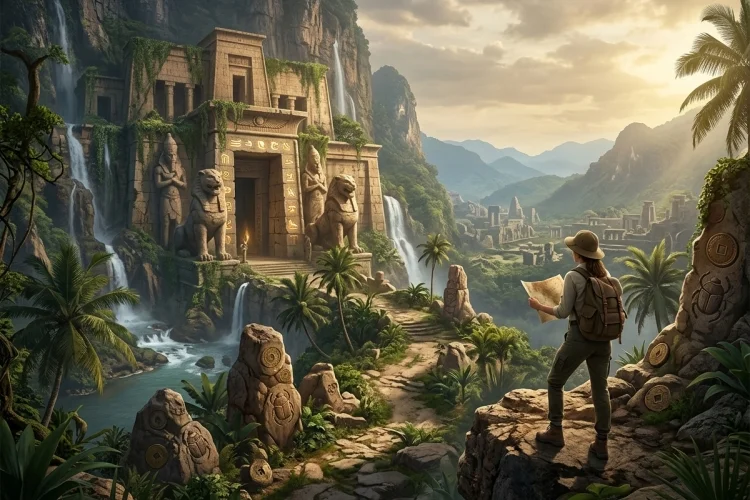
Adventure stories have always been built around mystery, risk, and discovery. That combination also works naturally in slot games, where ancient temples, lost cities, hidden islands, and legendary treasures provide the setting for each spin.
Adventure-Themed Slots usually mix familiar reel mechanics with characters, maps, artifacts, and bonus rounds that feel like stages of a journey.
Some titles follow explorers through Egyptian tombs, while others focus on jungle expeditions, underwater ruins, or fantasy kingdoms. The theme makes the presentation more engaging, but the results are still generated by the game’s underlying mathematics.
Understanding the most common features can help players read the paytable, follow the action, and choose a title that matches their preferred playing style.
Storytelling Through Characters and Locations
Most adventure slots introduce a central character, such as an archaeologist, treasure hunter, sailor, or fantasy hero. This character often appears on the reels as a high-value symbol and becomes the focus of bonus animations.
The location gives the game its visual identity. Reels may be placed inside a temple, cave, jungle, shipwreck, or forgotten city, while music and sound effects create a sense of movement.
Play’n GO’s Rich Wilde and the Book of Dead, for example, follows a treasure hunter exploring an Egyptian tomb. The game uses ancient artifacts, pharaoh symbols, and a magical book to connect its features with the setting.
Wild and Scatter Symbols
Wild symbols generally replace selected regular symbols to help form winning combinations. In adventure games, the wild may appear as a map, compass, hero, magical artifact, or treasure chest.
Scatter symbols usually unlock a special feature when enough of them appear. Unlike standard symbols, scatters may pay or activate bonuses without needing to land on a fixed payline.
Theme-Based Symbol Design
The symbols are usually chosen to support the story. An Egyptian adventure might include scarabs and statues, while a jungle title may use animals, masks, and explorer equipment.
These designs make the rules easier to remember, but players should still read the official paytable because the most visually impressive symbol is not always the most valuable.
Free Spins and Bonus Expeditions
Free spins are among the most common features in this category. Landing a required number of scatter symbols may unlock a separate round with additional spins, multipliers, special wilds, or upgraded reels.
In Book of Dead, three scatter symbols trigger ten free spins. One regular symbol is then selected to become a special expanding symbol throughout the feature.
Other games present the bonus as entering a hidden chamber or reaching the next stage of an expedition. The story changes, but the player should focus on the actual rules, including retriggers, symbol behavior, and prize calculations.
Expanding and Special Symbols
Expanding symbols can grow to cover several positions or an entire reel. They fit adventure themes because they create a visual moment similar to discovering a large treasure or opening a secret door.
Some games select the expanding symbol randomly, while others use a fixed wild or character symbol. The paytable should explain whether the symbol must appear on an active line or whether it pays from any position.
Special symbols can also become sticky, stacked, transforming, or walking wilds. These variations change how winning combinations are created but do not guarantee that a feature will produce a profit.
Cascading Reels and Multipliers
Cascading mechanics remove winning symbols and replace them with new ones. This can create several consecutive wins from one paid round.
NetEnt’s Gonzo’s Quest calls this system the Avalanche feature. Winning symbols fall away, new symbols enter, and consecutive avalanches can increase the multiplier before the sequence ends.
During the Free Falls round, the game uses higher multiplier potential than in the base game. This illustrates how adventure titles often make later stages feel more valuable or dramatic.
Maps, Progress Meters, and Unlockable Areas
Some adventure games include a map or progress meter that shows the player moving toward a destination. Collecting keys, coins, artifacts, or special symbols may unlock another reel, prize feature, or bonus stage.
These systems can create the feeling of progression, but players should check whether progress continues between spins or resets after each round. A meter shown on screen does not always mean a bonus is close.
For example, Scroll of Dead includes a locked sixth reel that can be opened through its scarab-key mechanic.
Random Outcomes Still Control Every Spin
Story elements do not turn a slot into a skill-based adventure game. The player may choose a stake or press a button, but the reel outcome is determined by the game’s random system.
The UK Gambling Commission requires random number generation and game outcomes in licensed remote games to be acceptably random. It also prohibits adaptive behavior that changes results to compensate for earlier wins or losses.
A long journey animation therefore does not mean the game is building toward a guaranteed reward. Each result should be viewed as uncertain.
Adventure-Themed Slots combine traditional reel play with explorers, treasure maps, free spins, expanding symbols, cascading wins, multipliers, and progress-style features.
Their strongest appeal often comes from the way mechanics are connected to a recognizable story.
Before playing, open the paytable and check how wins, scatters, wilds, bonus rounds, and collected items actually work. Do not assume that a map, meter, or dramatic animation guarantees that a major prize is approaching.
Set a fixed entertainment budget, choose a comfortable stake, and treat every spin as a random outcome. Enjoy the journey for its presentation rather than expecting the story to lead to predictable winnings.